
By Fiona Mwariama
As the national minority population has soared over the last 25 years the Black and Latino community has expanded its social and political influence.
Massachusetts has also grown increasingly diverse in the past two decades. Reflecting the trend, in 2006 the state elected its first black governor – Deval Patrick. In 2009 the city of Newton elected its first black mayor – Setti Warren. Boston has evolved form a predominantly Irish city to a multiethnic community.
“The government is getting closer at representing the population,” said Ayanna Presley, the first African American woman on the Boston City Council.
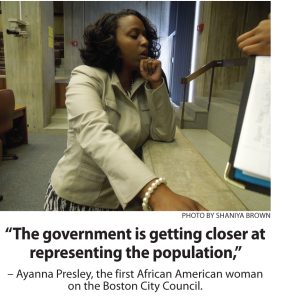
Councilor Presley is a testament that Massachusetts is undergoing a promising change.
“Diversity is essential,” stated Councilor Charles Yancey. “Fifty percent of the city-wide council are people of color.”
From state representatives to mayors, blacks and Latinos are taking giant leaps in political affairs.
“It’s not about the title,” stated Presley. “It is about making a difference and making an impact.”
Moreover, the rise in minority population and political diversity has spurred a sharp increase in the minority voter turnout. In 2008 when Barack Obama was elected into office, there was a 7.6 percent increased turnout in African American and Hispanic voters. The US Census Bureau indicates that nearly one in four votes in the 2008 election were cast by minority voters.
The hope of a black President fueled the communities and sparked their initiative. The election also reflected higher political engagement in minority youth. Blacks aged 18-24 had the highest turnout rate in that age group with 8.7 percent more voters than the 2004 election.
“When I go to a classroom I say raise your hand if you want to be this, raise your hand if you want to be that, and more young people are saying public service,” said Councilor Presley.
The rising ethnic and racial population has also lead to higher diversity in education.
Carole Johnson is an African American and the Boston Public Schools’ superintendent. Under her leadership BPS has had growing graduation rates for four consecutive years.
There has also been a growing rate of Black and Latino students in Ivy League schools. Harvard University, although still predominantly a white college, is showing growing numbers of minority students.
According to the Undergraduate Minority Recruitment Program, last year nearly 40 percent of the student body was comprised of minorities – the highest percentage in Harvard history.
Antonio Mendez, 25, is one of those students. He is of Mexican and Peruvian descent.
“I’m not used to being around people with a lot of money,” Mendez said of his experience at Harvard.
He felt “isolated.” However, his advice to young Latino students is to stay true to themselves in order to succeed.
“Follow your internal voice. Allow that voice to be the loudest.”
> ‘ “The government is getting closer at representing the population,” said Ayanna Presley, the first African American woman on the Boston City Council.’
Yet the Councilor has been ignoring the lack of public access to the clean clear text of the stenographic record of public meetings of Boston City Council. Boston City Council should be a model of the best practices of open government.